Etna DOC Wine Explained
What Etna Rosso, Bianco and Superiore are: the grapes, the 1968 rules, the contrada system and why the red pours so much paler than anyone expects.
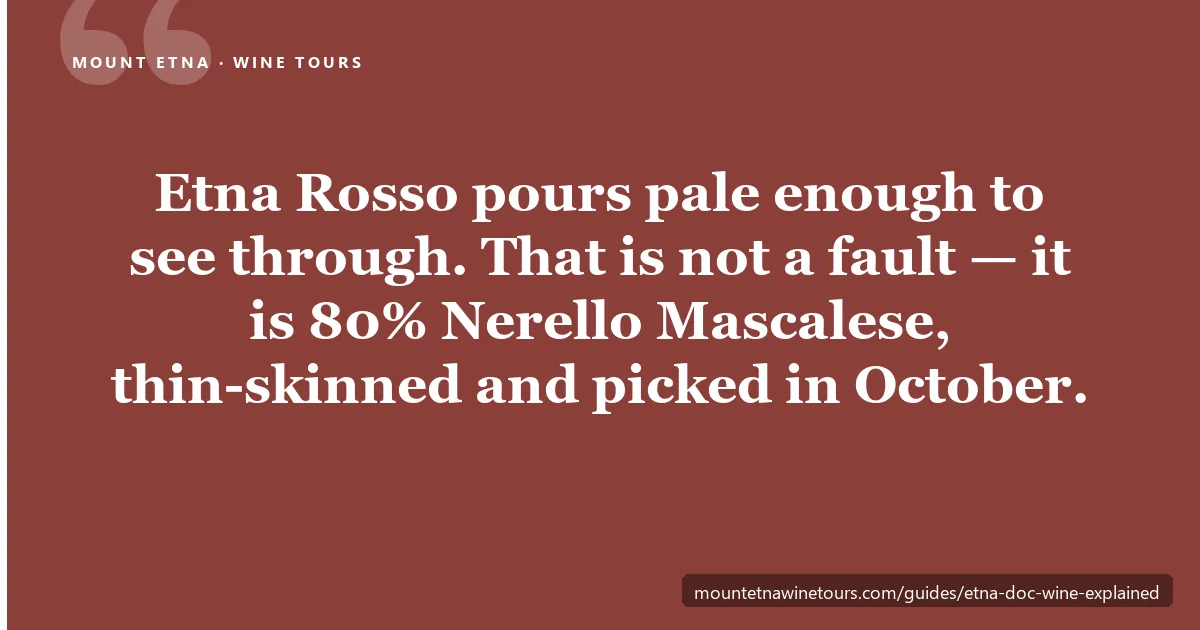
The single most common reaction at an Etna tasting is confusion at the colour. You have come to Sicily, the guide pours the red, and it is pale — translucent at the rim, nothing like the dense southern wine you were braced for. Nothing has gone wrong. That is what Etna Rosso looks like, and understanding why explains most of what makes this appellation unusual.
Check Availability
Etna DOC at a glance
| Category | Main grape rule | What to expect |
|---|---|---|
| Etna Bianco DOC | Carricante at least 60% | Fresh, citrusy, mineral, often saline |
| Etna Bianco Superiore DOC | Carricante at least 80%, grown in the Milo zone | More structured, Carricante-driven white |
| Etna Rosso DOC | Nerello Mascalese at least 80% | Red fruit, herbs, acidity, fine tannin |
| Etna Rosato DOC | Nerello Mascalese at least 80% | Dry, fresh, savoury rosé |
| Etna Rosso Riserva DOC | Etna Rosso with extra ageing | More developed, structured expression |
| Etna Spumante DOC | Traditional-method sparkling | Fresh sparkling styles from Etna grapes |
Rules can be amended over time, so treat this as an orientation table, not the disciplinare itself.
Etna DOC was Sicily’s first, in 1968
DOC stands for Denominazione di Origine Controllata — a protected designation that fixes where the grapes can be grown, which varieties are allowed and in what minimum proportions, maximum yields, ageing rules for some categories, and which geographic names, including contrada names, are permitted on the label.
The denomination was established in 1968, making it the oldest DOC on the island — which sits oddly with Etna’s reputation as a recent discovery. The vines were always here; what arrived in the last twenty years was outside attention and a wave of producers labelling by site rather than by blend.
The production zone runs around the volcano’s eastern, northern and southern flanks in the province of Catania, taking in communes including Biancavilla, Belpasso, Nicolosi, Paternò, Acireale, Giarre, Mascali, Zafferana and Milo. Vineyards sit between roughly 400 metres and well over 1,000 — among the highest in Europe — and a good number of the old plots are ungrafted, because the loose volcanic soils never suited phylloxera.
Etna Rosso: at least 80% Nerello Mascalese
The rules are specific. Etna Rosso must be a minimum of 80% Nerello Mascalese, with up to 20% Nerello Cappuccio (also called Nerello Mantellato) — the supporting grape, which typically brings deeper colour, softer fruit and a rounder, more aromatic edge to a blend otherwise dominated by Nerello Mascalese’s pale intensity.
Nerello Mascalese is thin-skinned and ripens late — picking usually falls in October. Thin skins mean little colour extraction; late ripening at altitude means acidity survives. The result is a wine with real tannin and real structure inside a pale frame, which is why the comparisons reached for are Pinot Noir and Nebbiolo rather than anything else grown south of Rome — Pinot Noir for the pale colour, the perfume and the red-fruit register; Nebbiolo for the acidity, the tannin and the capacity to age behind a deceptively light colour. Neither comparison should be taken too literally: volcanic soil, Mediterranean light and altitude give Etna Rosso its own character rather than a Sicilian copy of either grape.
Judge it on the palate, not the glass. It is the single piece of advice that changes people’s tastings.
Etna Rosso Riserva
Riserva is an aged category within Etna Rosso rather than a separate wine — the exact ageing requirements should always be checked against the current disciplinare, but the practical point for a visitor is simple: a Riserva has spent longer ageing before release and is generally a more developed expression of the same wine. Do not assume a Riserva automatically beats a non-Riserva bottle, though; a single-contrada wine from a strong producer is often more interesting than a generic Riserva blended across an estate’s holdings.
Etna Bianco: Carricante, and the Milo rule
Etna Bianco is a minimum of 60% Carricante, with Catarratto (comune or lucido) permitted up to 40%.
Etna Bianco Superiore is stricter: at least 80% Carricante, and it can only be made from grapes grown in the delimited zone within the commune of Milo, on the volcano’s eastern flank. That is one of the tightest sub-zone rules in Italian white wine, and it is why Milo bottles cost what they do.
Carricante is high-acid, citric and distinctly saline. At a tasting it is almost always poured first, and on a hot day it is frequently the wine people end up buying.
Rosato and sparkling are not afterthoughts
Most estates pour a rosato — Etna Rosato DOC is, like the red, a minimum of 80% Nerello Mascalese — and the pale skins that make the red translucent make the rosé genuinely good rather than a by-product.
There is also serious traditional-method sparkling on the mountain, again mostly from Nerello. If a tasting offers it, take it — the altitude-driven acidity is exactly what a base wine for metodo classico wants.
To compare a sparkling wine with Etna Bianco, Rosato and Rosso in one flight, Tornatore’s four-wine cellar tasting includes those styles with a tasting board. It was listed as a new activity on 15 September 2026.
Contrade: the reason two bottles taste different
The word you will hear all day is contrada — a named parcel. Etna is not one terroir but dozens: different lava flows of different ages, different aspects, altitudes from 400 to over 1,000 metres, and soils that change over a few hundred metres of hillside.
That is why serious producers now label by contrada rather than blending across the estate, and why a north-slope wine from Passopisciaro tastes materially unlike one from Milo on the east. On a visit it is worth asking which contrade the wines in front of you came from; on the north slope the answer is usually the thing the estate is proudest of. See Etna Nord and Etna Sud for how the two sides differ, or the full Etna wine region guide for the geography behind the labels — which villages sit where, and which side suits red or white drinkers.
Names you are likely to encounter on a label or a tasting sheet include Calderara Sottana, Guardiola, Feudo di Mezzo, Santo Spirito, Rampante, Sciaranuova, Porcaria and Solicchiata — a small sample of the roughly 133 the Consorzio di Tutela Vini Etna DOC identifies across the denomination. You do not need to memorise them. When a winery offers a contrada tasting, four questions teach more than the name alone: where is this contrada, what altitude, how old is the lava underneath it, and what makes it different from the estate’s other vineyards?
Old vines, alberello, and why some Etna wine costs what it does
Some Etna vineyards hold genuinely old vines, including ungrafted ones — a consequence of the loose volcanic soils, which historically gave phylloxera more trouble establishing itself than in most European vineyard soils. That let pockets of pre-phylloxera vines survive, though the term should never be assumed just because a bottle says Etna; not every old vineyard is ungrafted, and not every producer says so on the label.
Many of those old vines are trained as alberello — the traditional bush-vine system used across the Mediterranean, low-growing and worked by hand rather than by machine, on lava terraces held up by dry-stone walls. That labour is one honest reason Etna wine is not always the bargain visitors expect from Sicily: steep sites, hand-farmed terraces, low yields, fragmented plots and strong international demand for the best contrada wines all push the price up, particularly for small-production, single-vineyard bottlings. A basic Etna DOC blended across an estate’s holdings can still be good value; the region also makes serious, expensive fine wine, and the two are not the same product.
Entry-level Etna DOC vs contrada wine
An entry-level Etna DOC usually blends fruit from several plots to express a producer’s general house style — the sensible place to start, and a fair way to judge a producer before spending more. A contrada wine focuses on a single named site, built for comparing terroir more than for easy drinking at a restaurant table. Neither is automatically better; a contrada bottling is simply more specific about where it came from.
Tasting it in the right order
Almost every Etna tasting runs white → sparkling → rosato → red, and there is a reason beyond convention: the Carricante resets your palate for a red that would otherwise read as thin.
The premium tasting at Linguaglossa pours five current vintages that way with a full food pairing for $68, at an estate 900 metres up on the north-eastern slope. The four-glass version at the same winery is $47. Neither includes transport — our breakdown of the premium tasting →
If you would rather someone drove, the half-day tastings from Taormina start at $67, and the wine tasting page compares the pure-tasting formats.
What should beginners taste, and what should serious drinkers ask for?
If you are new to Etna, start with an Etna Bianco and a standard Etna Rosso — together they show the two sides of the denomination immediately. Add a Rosato and a contrada wine if the estate pours one, and you have covered most of what the appellation does in a single flight.
If you already know wine and want more, ask for single-contrada bottlings, older vintages, ungrafted or old-vine wines, Carricante specifically from Milo, and Nerello Mascalese from North Etna. A winery that lets you compare two vineyard sites side by side is worth more of your time than one that simply pours its full commercial range in order.
What food pairs with Etna wine?
Etna Rosso is genuinely food-friendly thanks to its acidity — roast or grilled meats, mushrooms, aubergine, tomato-based pasta and aged cheeses all work well. Etna Bianco leans toward the coast: seafood, shellfish, swordfish, grilled fish and citrus-forward Sicilian cooking suit its saline, high-acid character. If a tasting includes food and you have a choice, ask for whatever matches the wine in front of you rather than a generic platter — it is the fastest way to understand why the acidity is there in the first place.
Does Etna wine age?
Many examples do. Etna Rosso can develop dried fruit, leather, tobacco and forest-floor notes with real bottle age; Carricante-based Etna Bianco can turn waxy and honeyed, with preserved citrus and deeper mineral character. Not every bottle is built for the cellar — plenty of entry-level Etna DOC is designed to be opened young — but premium contrada wines, in particular, should not be assumed to need drinking immediately.
How to read an Etna wine label
Six things to look for, roughly in the order they matter:
- Etna DOC — confirms the denomination itself.
- Rosso, Bianco, Rosato or Spumante — tells you the style.
- Producer — matters more than almost anything else, since house style varies enormously between estates.
- Vintage — matters because Etna wines can change significantly with age.
- Contrada name, when present — points to a specific site rather than an estate-wide blend.
- Riserva — marks the regulated aged category within Etna Rosso.
Is Etna DOC better than Sicilia DOC?
That is the wrong comparison to make. Etna DOC is a geographically specific denomination tied to the volcano and its grapes; Sicilia DOC covers a far broader area, many more grape varieties and a wider range of styles across the whole island. Neither is automatically superior — Etna DOC is the relevant designation if what you want to understand is Mount Etna’s own terroir specifically.
Ordering Etna wine off the menu, away from the volcano
Etna DOC travels well around Sicily even if a winery visit is not on the itinerary — it shows up on wine lists in Catania, Taormina, Palermo and Syracuse. As a rule of thumb, reach for Etna Bianco with seafood and Etna Rosso with meat, mushrooms or aubergine dishes; if a restaurant pours both by the glass, ordering one of each is an easy, low-commitment introduction to the appellation.
Frequently asked questions about Etna DOC wine
What is Etna DOC wine?
Wine produced within the regulated Mount Etna denomination in Sicily, under rules covering geography, permitted grapes and production methods.
What grape is Etna Rosso made from?
At least 80% Nerello Mascalese, with up to 20% Nerello Cappuccio permitted in the blend.
What grape is Etna Bianco made from?
At least 60% Carricante, with Catarratto permitted for the remainder.
What is Etna Bianco Superiore?
A stricter category requiring at least 80% Carricante, made only from grapes grown in the delimited zone within the commune of Milo.
What does Etna Rosso taste like?
Red cherry, wild strawberry, dried herbs and spice, with fresh acidity and fine but noticeable tannin behind a colour paler than most visitors expect.
What does Etna Bianco taste like?
Citrus, green apple, white flowers and a saline, mineral edge, with enough structure in the best examples to age well.
What is a contrada?
A named vineyard district within the Etna DOC territory, used to identify a single site instead of an estate-wide blend.
How many Etna contrade are there?
The Consorzio di Tutela Vini Etna DOC describes roughly 133 across the denomination.
Is Etna wine expensive?
Basic Etna DOC can be reasonably priced; premium single-contrada, old-vine and small-production wines can cost considerably more, driven by steep, hand-worked vineyards and strong demand.
Is Etna wine actually volcanic?
Geographically, yes — the vines grow on volcanic soils around an active volcano. Treating the flavour as a direct transfer of “lava” into the glass oversimplifies what is really altitude, drainage and soil structure working together.
Final verdict
Etna DOC is distinctive because several unusual factors land in one place: active volcanic geology, high-altitude vineyards, real differences between slopes, native grapes found almost nowhere else, and a contrada system that increasingly appears on the label rather than staying in a producer’s tasting notes. For red wine, start with Nerello Mascalese and Etna Rosso; for white, start with Carricante and Etna Bianco; for a real sense of what makes the region distinctive, taste two wines from different contrade side by side. If you are visiting Mount Etna itself, do not treat the winery as an optional extra — it is one of the clearest ways to see how people have farmed an active volcano, and why Etna has become one of Sicily’s most talked-about wine regions.
Related guides
Taste Etna Where It Grows
Cellar visits, Etna DOC tastings and vineyard lunches on the slopes of an active volcano — leaving Taormina and Catania most mornings. Free cancellation on every tour compared here.
Check Availability & Book